


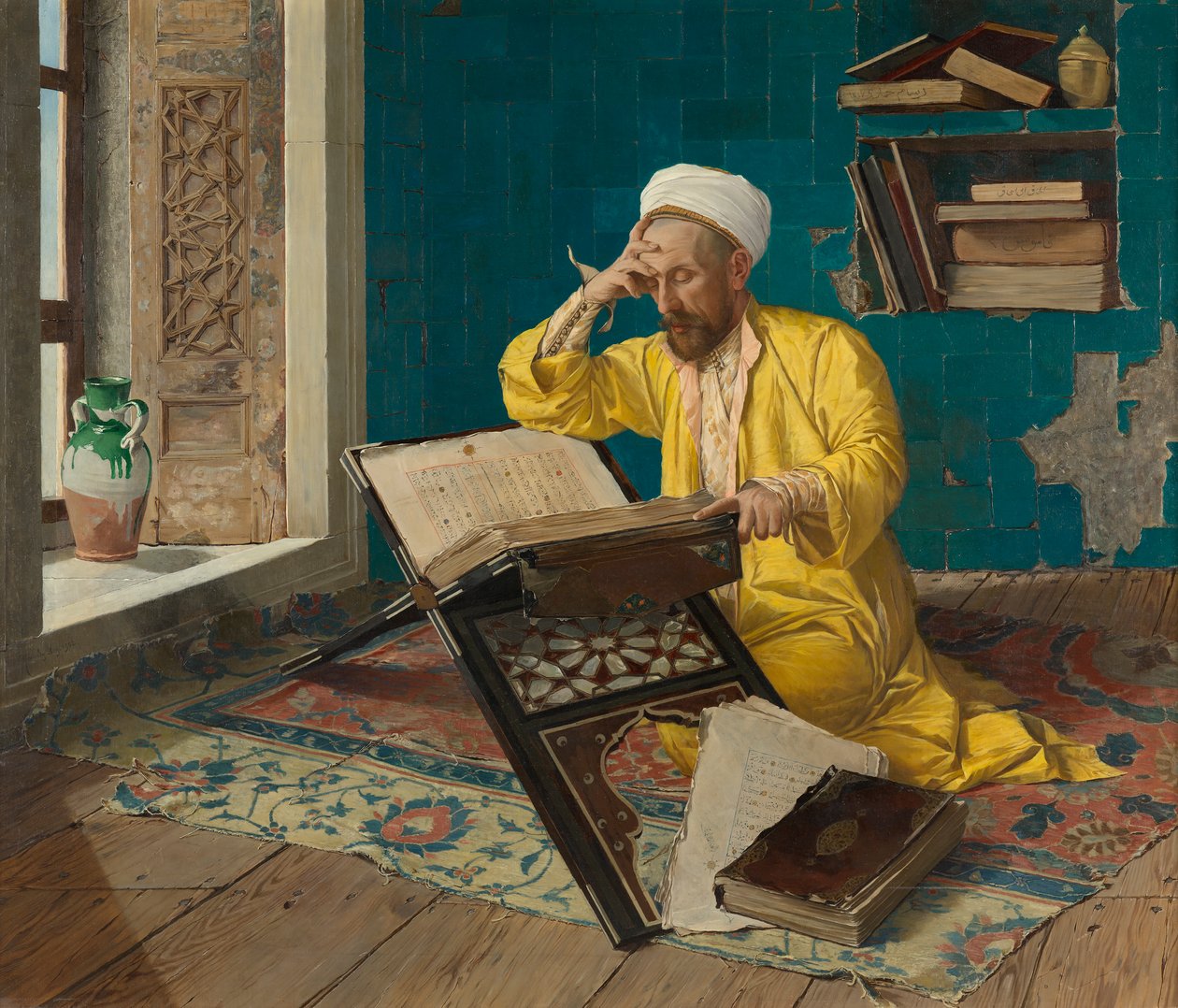
Orientalism: Between Fact and Fantasy is an exhibition at The Metropolitan Museum of Art (The MET) in New York, on view from June 12, 2026, to February 28, 2027. The exhibition explores the representation of “the East” in nineteenth-century art and the cultural exchanges between Europe and the Middle East.
Introduction
In ancient Rome, the Latin root of the word “Orient” denoted the direction of the rising sun—the east. The exhibition Orientalism: Between Fact and Fantasy explores notions of “the East” in the art of the nineteenth century, when globalism, shaped by colonialism and imperialism, fueled unprecedented encounters and exchanges in Europe and the Middle East. Modern forces, such as accelerated travel, rapid technological change, and shifting geopolitics, hastened connections between distant regions and different cultures: “soft power” mingled with “hard power.”
The stories told in this exhibition unfold from Napoleon’s conquest of Egypt in 1798 and culminate in the paintings of the Ottoman polymath Osman Hamdi Bey at the turn of the twentieth century. Islamic artworks made their way to European dealers, collectors, international expositions, and museums, introducing a new visual language to artists, architects, and designers that transformed public and private spaces in the broader Atlantic world. Artists such as Ingres, Delacroix, and Gérôme visited lands and people across the Mediterranean or imagined them from afar. Sometimes they depicted what they saw, at other times they conjured distant places through memory and imagination, often using Islamic objects to stage their paintings.
Orientalism: Between Fact and Fantasy occupies four galleries that straddle the departments of European Paintings and Islamic Art. Visitors are welcome to approach the exhibition from its primary entrance in Gallery 453 or explore its themes from multiple points of entry.
France in Egypt: Power through Knowledge
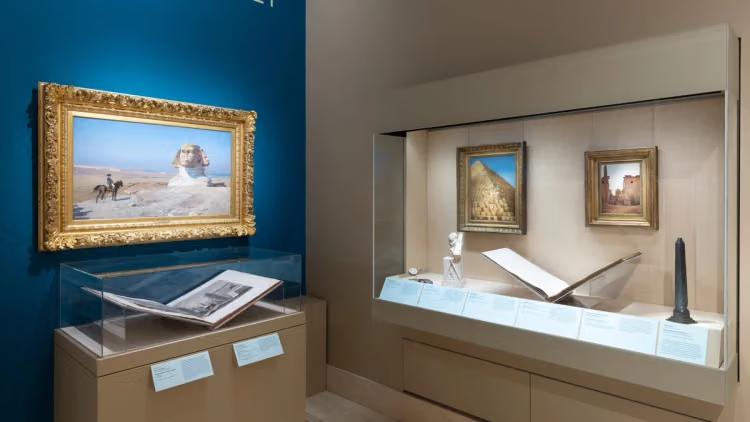
The artworks assembled here reflect a pivotal moment widely considered foundational to Orientalism. In 1798, Napoleon led a military campaign to Egypt, driven by France’s rivalry with Great Britain over control of trade routes to India and beyond. Although the French campaign ended in failure in 1801, France maintained influence in the region by supporting modernization efforts, including the development of infrastructure such as railways and ports.
© Met Museum
Napoleon’s military expedition was also intellectually ambitious. A mission to study and document Egypt’s civilization led to major illustrated publications that systematically documented Egypt’s cultural heritage, laying the foundation for the fields of Egyptology and Islamic art—and worldwide fascination with the “exotic” East.
The Alhambra: Gateway to Orientalism
During the nineteenth century, the Alhambra, a Nasrid period (1232–1492) palace complex in Granada, Spain, emerged as an alluring center of travel and study. Though located in southwestern Europe, al-Andalus, due to the region’s Islamic history, was often the first stop for Europeans and Americans on their tour of “the Orient.” As a result, the Alhambra became a “gateway to the East.” By mid-century, fascination with the Alhambra had inspired artists and writers around the world. In the 1830s, it increasingly became the subject of scholarly studies. The beauty of the Alhambra’s architecture added to its appeal and led to an international Alhambresque style, often called “Moresque” or “Moorish” at the time, and the Alhambra’s Court of the Lions and Comares Palace became preferred settings for Orientalist paintings. Images made by early photographers further heightened the allure of this “exotic” site.
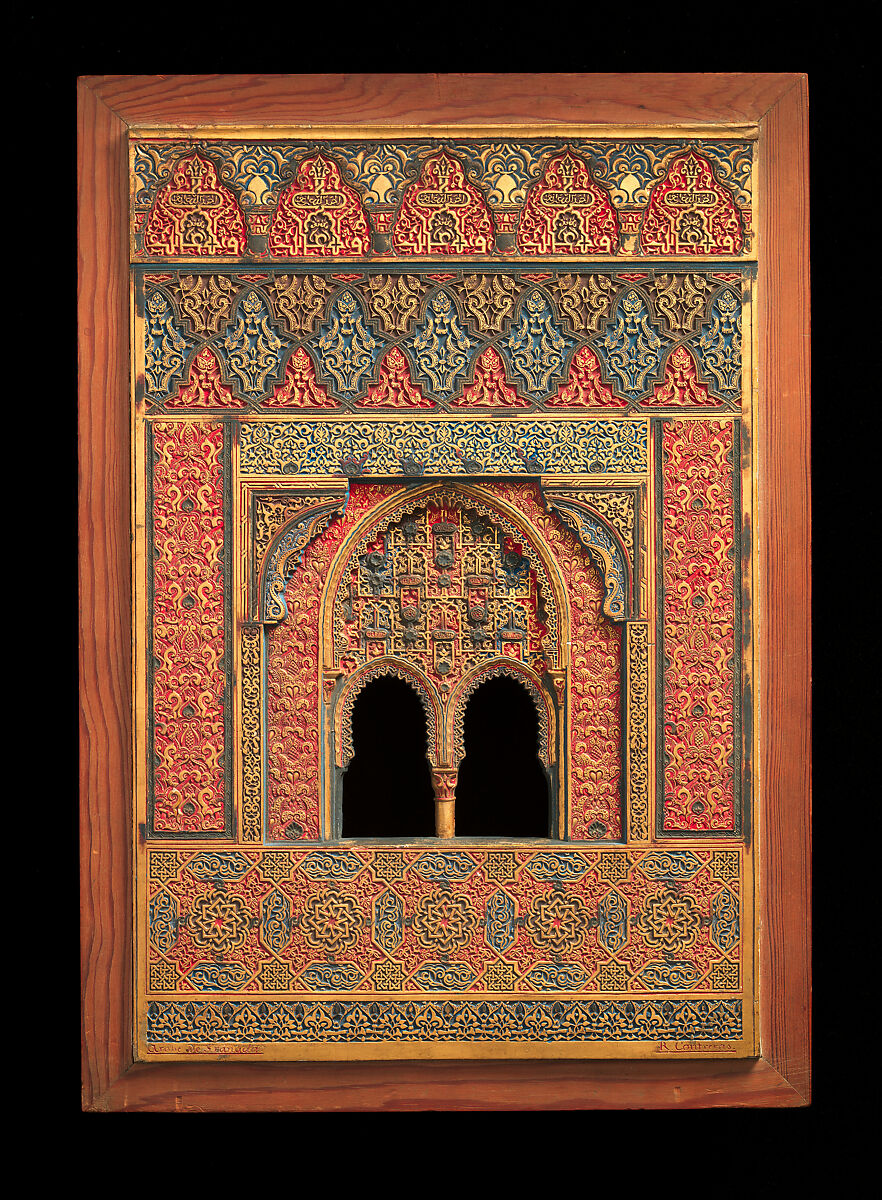
Architectural Model Based on the Alhambra, Rafael Contreras (1847-1890) © Public Domain MET
Spanish Revival: Refashioning the Alhambra
In 1847 Queen Isabella II of Spain appointed the architect Rafael Contreras to restore the Alhambra. He refashioned the site as a fantasy space for tourists. For the royal bath, Contreras kept the original decoration but opted for a palette of primary colors and gold in response to renderings of the palace by the British designer Owen Jones circulating at the time. The project sparked an Alhambresque revival that came to define Spanish cultural identity.
Alhambra Vases
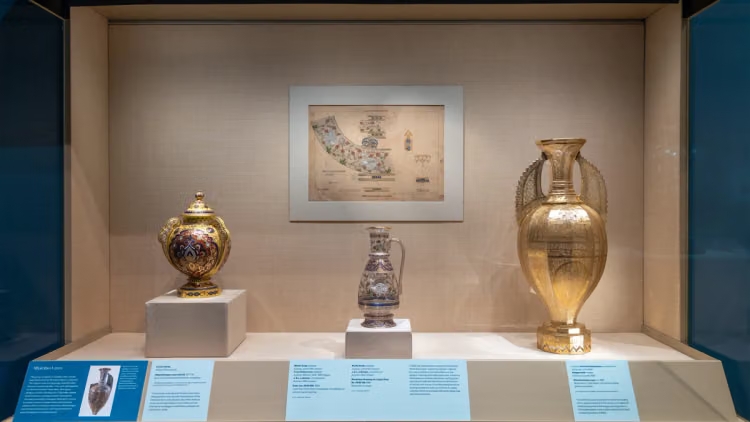
This group of objects is modeled after vessels associated with the Alhambra Palace in Granada. The original vases had large egg-shaped bodies and two wing-like handles. They were distinguished by shimmering luster decoration; blue figural designs, notably including pairs of gazelles; vegetal ornamentation; and elegant poetic inscriptions conveying meaningful messages. Nineteenth-century European potters and glassmakers admired these vases for their harmonious proportions, refined design, and technical sophistication, and they produced an array of imaginative reinterpretations.
© MET Museum
Owen Jones
In the nineteenth century, a group of European critics and designers came to believe that industrialization had created a “crisis of representation.” They denounced the products being made and exhibited in their countries and sought to reform design education and practice. Seeking inspiration among other cultures, they found beauty in Islamic art and encouraged artists to learn from Islamic design traditions.
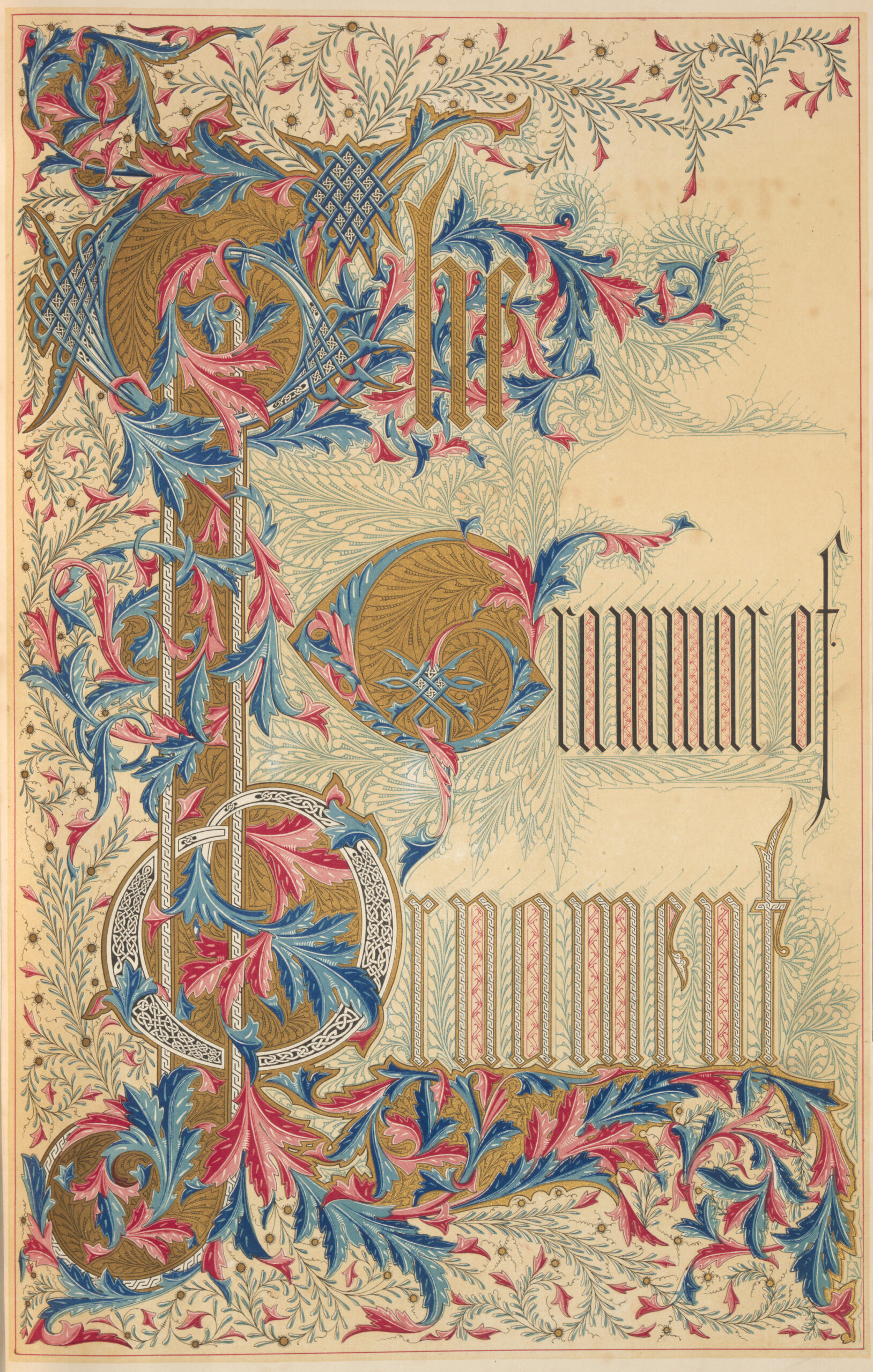
The grammar of ornament, Owen Jones (1856) © Public Domain MET
Through his theories, teaching, and architectural projects, Owen Jones became a leading voice in these reforms, inspiring at least three generations of architects, artists, and designers. This “Master of Polychromy” positioned the Alhambra at the center of architectural and design debate in Britain. Moreover, he galvanized interest in Islamic design in Europe and the United States through his landmark book, The Grammar of Ornament (1856; on display).
Delacroix in Morocco
In 1832, Eugène Delacroix became the first French artist to visit Morocco, making excursions to Spain and Algeria. He returned to Paris not only with six months’ production of sketchbook studies and diary entries describing the people, places, things, customs, and events he witnessed, but also objects emblematic of a culture hitherto unfamiliar to him. In the same year, British architect Owen Jones visited Granada, Spain, where he pursued deep study of the Alhambra palace complex. Although Delacroix and Jones never met, their respective sojourns fed their creative processes for the rest of their lives, serving as models for others to emulate.
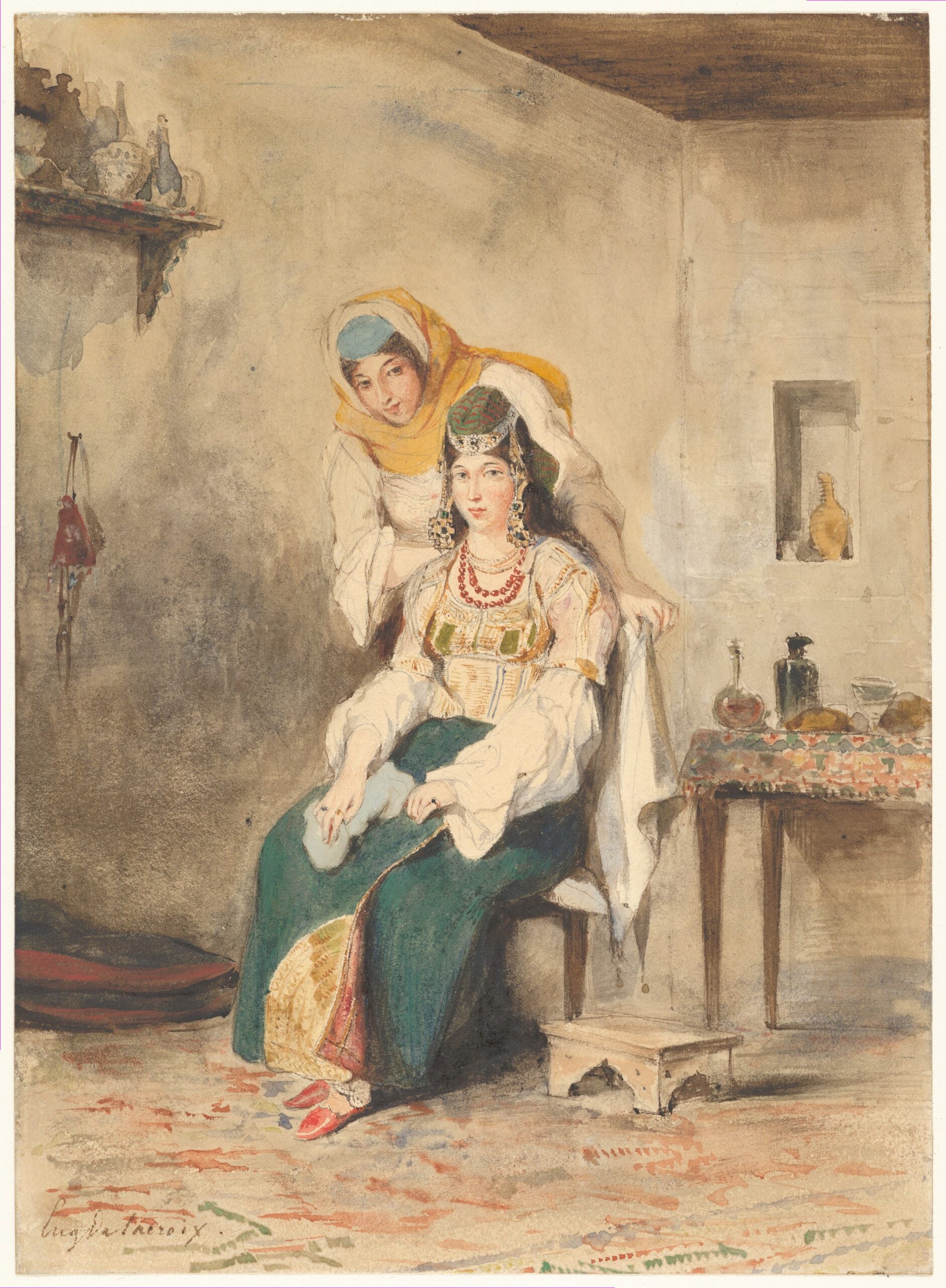
Saada, the Wife of Abraham Ben-Chimol, and Préciada, One of Their Daughters, Eugène Delacroix (1832) © Public Domain MET
Hard and Soft Power: Orientalism and Design
In the nineteenth century, international expositions represented the world in microcosm. Designed to showcase progress, political supremacy, and national identity and culture, these events helped stimulate interest in Islamic art. As a result, European and American architects, artists, designers, and manufacturers had greater contact with the people and cultures of the Islamic world and developed a deep admiration for its techniques and forms. Islamic styles were perceived as novel, filling a perceived aesthetic void in “the West.” Architects, artists, and designers revived historic techniques and emulated the arts of the East, often creating imaginative reinterpretations rather than direct copies. These novel objects transformed everyday life in the West by providing alternatives to industrialization and mass production: what the British architect Owen Jones called the “Age of Ugliness.”
Enameled and Gilded Glass
Syro-Egyptian enameled and gilded glass was greatly admired in the nineteenth century, and many examples were acquired by elite private collectors based in Paris who shaped the art market. Whether medieval originals or nineteenth-century replicas and emulations by Philippe-Joseph Brocard and other French designers, these objects became popular in Europe and the United States due to the extraordinary variety of venues in which they were displayed.
Emulation and Inspiration
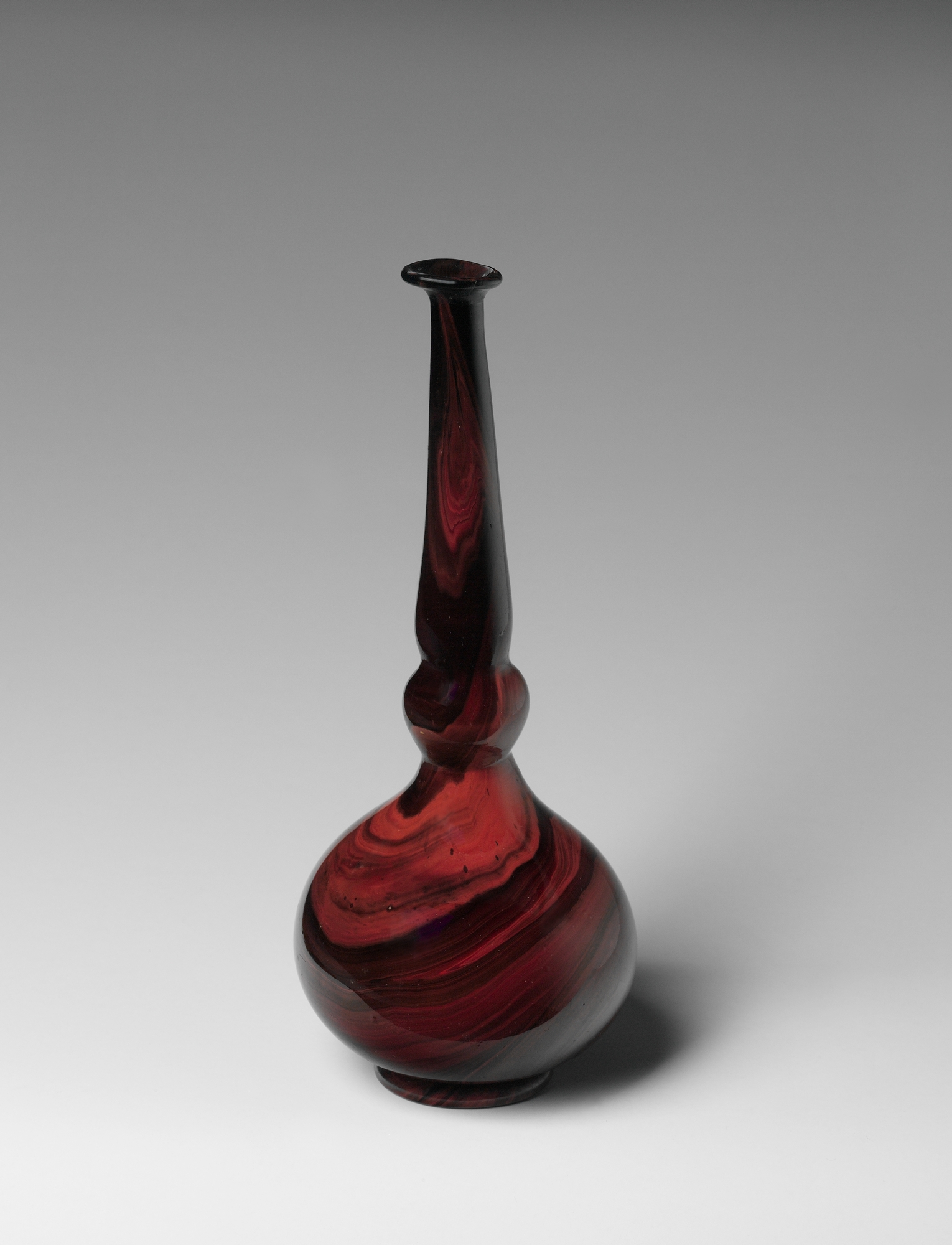
Rosewater Sprinkler (late 18th–19th century) © Public Domain MET
International expositions in London, Paris, Vienna, and Istanbul shaped artistic tastes and fostered an unprecedented appreciation for Islamic art and design. They also served as hubs of exchange among collectors, dealers, and artists. Inspired by the beauty and craftsmanship of Islamic works, European and American designers, metalworkers, glassmakers, and potters began to emulate them, producing both faithful copies and imaginative reinterpretations.
This section brings together a series of pairings and groupings that juxtapose Islamic ceramics, glass, and inlaid metalwork with their European and American counterparts. Artists and designers such as Brocard, Dresser, Deck, and Tiffany drew on Islamic sources in different ways, ranging from close reproductions to fanciful and innovative adaptations.
Edward C. Moore, Designer and Collector
The silversmith Edward C. Moore was the creative force behind Tiffany & Co. in the late nineteenth century. His voracious appetite for sources of inspiration is manifest through the vast collection he amassed, with objects whose origins range from East Asia to Greek antiquity. Moore was a pioneering American collector of Islamic art, and his passion for Islamic inlaid metalwork, among other traditions, transformed American silver wares. His bequest to The Met featured about four hundred works from the Islamic world, including metalwork, ceramics, glass, textiles, jewelry, and armor; it remains the largest and most comprehensive collection of Islamic art to have ever entered the Museum. Fifteen of the works are shown in this exhibition, and eleven are in this gallery.
Transformative Networks: Dealers, Artists, Collectors
The second half of the nineteenth century witnessed a shift in the way objects from the Islamic world were valued, collected, and presented in Europe and America. No longer seen as mere ethnographic curios, Islamic objects were appreciated as works of art in their own right. This evolution stimulated the formation of important private and public collections of Islamic art in Paris, London, Vienna, Berlin, and New York, as well as in Middle Eastern cities such as Constantinople and Cairo. Islamic objects circulated across the Mediterranean and the Atlantic world through networks of dealers, artists, businessmen, and other collectors.
In Paris, the dealer Albert Goupil and his brother-in-law, the artist Jean-Léon Gérôme, emerged as influential tastemakers, selling Islamic objects and organizing exhibitions. Goupil’s “salon arabe” gallery not only sold Islamic art but also became a model Orientalist interior, inspiring visiting artists, designers, intellectuals, and collectors. The Union Centrale des Beaux-Arts Appliqués à l’Industrie (later the Musée des Arts Décoratifs) pioneered the display and promotion of Islamic art and style. And the groundbreaking Galerie Orientale at the 1878 Exposition Universelle marked a turning point in the reception of Islamic art in France that reverberated across Europe and the United States.
The Persian Pavilion at the Vienna International Exposition
In the late nineteenth century, world’s fairs increasingly displayed original works from Iran and Persian-inspired objects made in Europe and the United States. Persia (Iran), however, did not have its own pavilion at one of these events until the 1873 Vienna International Exposition.
The Persian pavilion there featured Safavid-inspired architecture and included displays of a wide range of objects: rare manuscripts and folios (such as those from the Hamzanama; example on display), carpets and textiles, ceramics, metalwork (like the money container shown nearby), scientific instruments, minerals, and even agricultural products. The Persian monarch, Nasir al-Din Shah Qajar, visited the exposition with the Austrian emperor Franz Joseph I. Their meeting and the pavilion’s treasures were widely reported in illustrated European newspapers.
Ottoman Aspirations
In the mid-nineteenth century, Sultan ‘Abdülaziz aspired to have the Ottoman Empire join the elite club of the world’s leading nations. One way to accomplish this goal was to participate in world’s fairs. Beginning with the 1867 Exposition Universelle in Paris, the Ottoman Empire sponsored pavilions at these events.
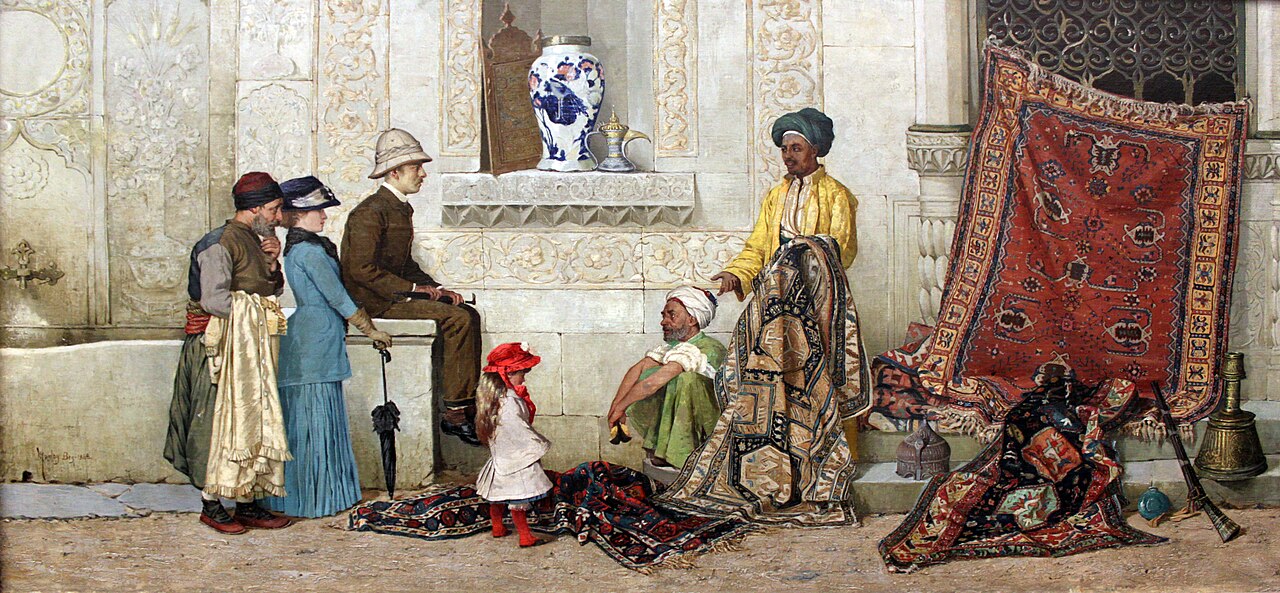
Turkish Street Scene (Türkische Straßenszene), Osman Hamdi Bey (1888) © Wikimedia
World’s fairs brought distant lands closer and offered visitors the chance to explore “exotic” cultures without having to endure long-distance travel. These exhibitions staged the Islamic world through fantasy-driven stereotypes comparable to those found in Orientalist paintings, only experienced in person. At the 1873 Vienna International Exposition, the Ottoman government impressed audiences with a luxurious structure called the “Sultan’s Treasury” that exhibited the dynasty’s crown jewels alongside displays of Ottoman fashion. Indeed, luxurious garments and accessories from the Islamic world became popular and were increasingly collected by artists and institutions following their display in these events. Among the most successful entertainments on offer were spectacles thought to be part of life in the harem, such as belly dancing, that nurtured fantasies about the opulent life of a sultan.
Persomania
Admiration for Persian art and culture grew in Europe and the United States after the 1870s, due in part to prevailing linguistic and racial theories that saw Persians as closer to Europeans than other Middle Eastern peoples. As a result, Persia came to be seen as the primary source of artistic creativity in the Islamic world, blurring distinctions between Persian, Indian, Arab, and Turkish art. Many objects were labeled “Persian” regardless of origin, and the term became a general marker of quality and market value.
Facing the Orient
In this gallery, visitors are invited to explore works of art that document encounters between people who moved between Europe and the Middle East. Each picture is a portrayal of one or more persons, and all are marked by the circumstances that brought artist and subject together. In the European tradition, a “likeness” records an individual’s appearance; a “portrait” provides more context about the sitter; and a “type” prioritizes qualities associated witha group to which the individual belongs. In many of the pictures here, the nuances of these categories may seem to overlap. Nineteenth-century artists were deeply engaged by the possibilities of portraying people of “the Orient” and the abundance of techniques and materials with which to work, from painting to photography.
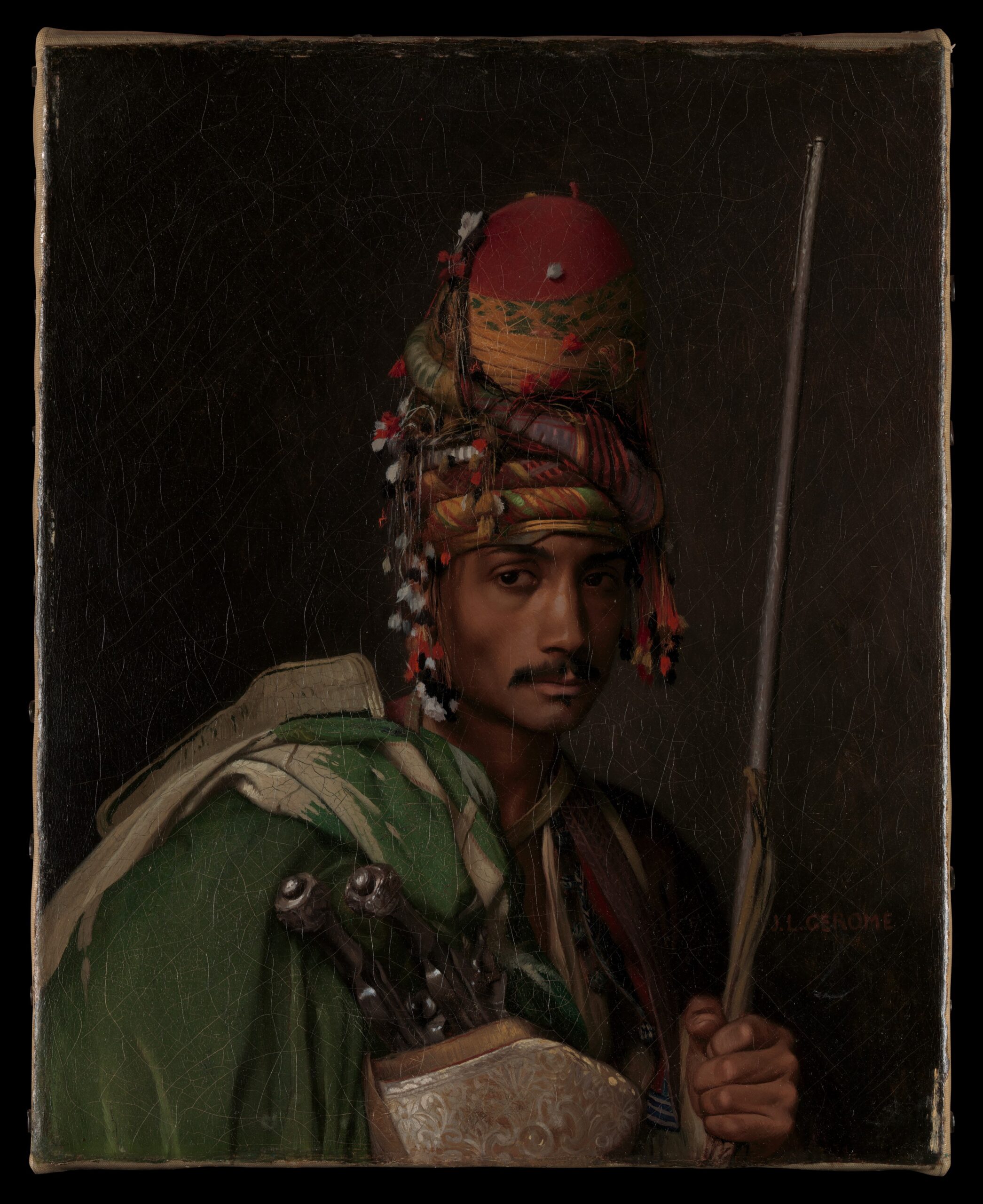
Bashi-Bazouk, Jean-Léon Gérôme (ca. 1868–69) © Public Domain MET
Osman Hamdi Bey: Depicting the Orient as an Insider
Exchange between “East” and “West” in the nineteenth century did not consist solely of Westerners looking east. The Ottoman polymath Osman Hamdi Bey was an administrator of antiquities and a French-trained painter who developed a personal style to depict his world through an insider’s lens. His bold, warm colors; decorative elements; and close-up views are reminiscent of Ottoman art and painting, while also conveying a contemporary sensibility. His compositions combine academic polish with liberal brushwork and embrace various artistic traditions: Orientalist, Ottoman, and modern. Hamdi often incorporated portraits of himself, family, and friends into his paintings, and his scenes reflect a unique sensitivity to and deep respect for the sociocultural mores of Ottoman society.
Primarily intended for Western audiences, his compositions appear more authentic and personal and less burdened by the stereotypes so often found in European and American Orientalist paintings. Inscriptions and other details add metaphorical layers of meaning that invite debate and scrutiny. Hamdi’s compositions pushed the boundaries of Orientalism in the West, while in the East they transformed and modernized Ottoman painting.
Shaping a Unique Orientalist Vision
Between 1878 and 1881, Osman Hamdi Bey stepped away from his administrative duties to devote himself to painting. During this productive time, his approach to Orientalist painting crystallized and would inform his work for the rest of his career. Building on his formative years in Paris (1860–69) and driven by his passion for portraiture, Hamdi continued to prioritize the human figure, usually positioned singly or in groups of two in the foreground of his compositions, which offer close-up views. Architectural elements—such as Ottoman ceramic tiles, portals, niches, and windows from mosques, tombs, palaces, and monumental fountains—often frame the space, focusing the viewer’s attention on the action of the scene. Like Jean-Léon Gérôme and other French Orientalists, he constructed his pictures like a stage set, reusing a repertoire of architectural elements, props, figures (often friends, family, and even himself), and poses to create different scenes. Using such techniques and conscious of his audience, Hamdi positioned his actor-figures to create an interplay of gazes that guide viewers through the scene.
From Prayer to Modern Life
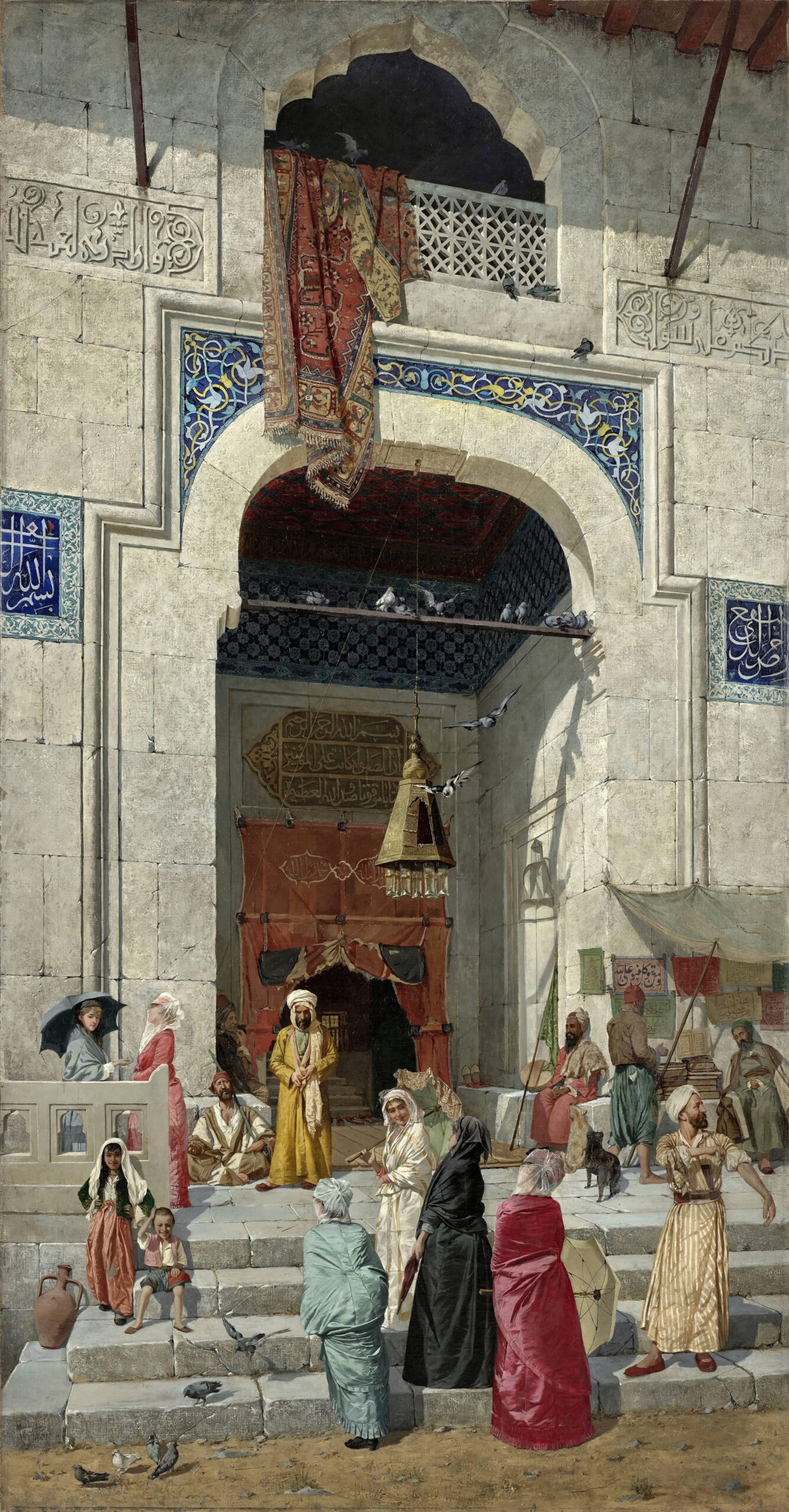
At the Mosque Door (Ҫami Kapisinda), Osman Hamdi Bey (1891) © invaluable.com
Many Orientalist painters were fascinated by the subject of Muslim prayer as an example of an “exotic” practice of “the other.” Osman Hamdi Bey liberated his paintings from such stereotypes that seem frozen in time. His portrayals of Islam and the public space of the mosque emphasize daily life and articulate a sense of authenticity and modernity.
The monumental portal of the fifteenth-century Muradiye Mosque in Bursa, the first Ottoman capital in Turkey, was a setting he returned to several times. He would adjust the details to suit a given composition, inserting calligraphic panels and additional details from other buildings, inventing a staircase, or expanding the stage to add more figures and drama. In At the Mosque Door (displayed here), for example, everything contributes to a vivid sense of immediacy in which the viewer is a witness to an event as it unfolds.
Playing the Role
Osman Hamdi Bey often donned costumes and photographed himself to prepare his paintings. Sometimes he would use several different photographs, each one showing a different posture, to refine the arrangement of the figures in a composition. Working in this way had several advantages. First, professional sitters were scarce in Constantinople. Second, in an Ottoman environment where painting from life was discouraged, working from photographs was an acceptable way for Hamdi to achieve the realism he had embraced as a student in Paris.
Several works feature the figure of a Muslim scholar, based on the artist’s own likeness. By stepping into this role, Hamdi not only cast himself as a participant in his Orientalist scenes, but he also expanded considerations of Islam to celebrate the intellectual pursuit of reading, reciting, and discussing the Qur’an.
Beyond Voyeurism
Women play a fascinating role in Osman Hamdi Bey’s pictures. As was common for Orientalist painting, he depicted women in fictional interiors that evoke palaces or harems. While they may be shown in standard roles—serving coffee or performing their toilette—they are never eroticized. Hamdi’s women project intellectual and cultural sophistication through their refined poses and actions: reading, playing music, gathering and arranging flowers, strolling gracefully and independently through Constantinople wearing fashionable attire that mixes Ottoman and Western styles. His paintings thus offer a stark contrast to the stereotypical Orientalist images of women composed by generations of Western men who could never have witnessed the scenes they depicted. By liberating women from voyeurism and showing them participating in modern life, Hamdi’s compositions offer striking parallels to the scenes of modern life depicted in Paris around the same time by such artists as Jean Béraud.
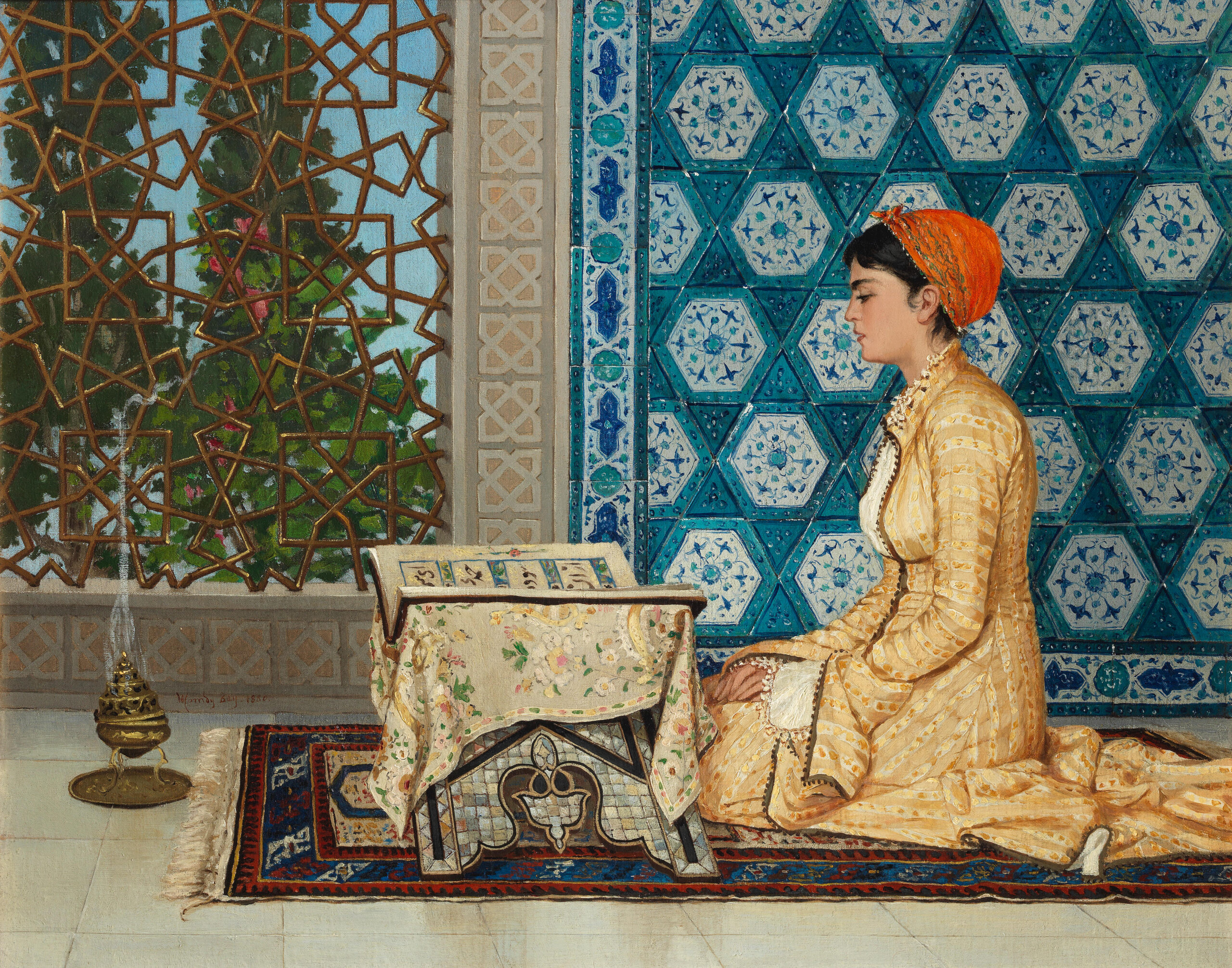
Young woman reading, Osman Hamdi Bey (1880) © Wikimedia
Fashion Bridges East and West
Women’s apparel reveals the changes prompted by the nineteenth-century cross-cultural dialogue between the Ottoman world, Europe, and the United States. Ottoman women continued to wear traditional entari robes, yet they increasingly embraced Western fashion. For example, Ottoman women wore European-style dresses at the reception honoring the French Empress Eugénie during her 1869 visit to Constantinople. Designers in the West, in turn, admired the luxurious fabrics and decorative styles of the Ottoman world.
Art, Archeology, and Diplomacy
In 1881 Osman Hamdi Bey became director and curator of the Ottoman Imperial Museum in Constantinople. In this role, he organized the first Ottoman archaeological mission to Nemrut Dağı in southern Turkey, where he beat a German team already in the field to uncover the colossal sculptures of the Commagene tumulus in 1883. The next year he revised the Ottoman law governing antiquities, canceling the practice of sharing finds with the (mostly foreign) excavating parties. Moving forward, the Imperial Museum would be the repository for all discoveries. Hamdi also played an instrumental role in negotiating excavation permits, effectively positioning himself as the gatekeeper to whom all foreign archaeologists had to apply in order to excavate in or export from the Ottoman Empire. Unsurprisingly, Hamdi—and his art—became part of a complex web of diplomatic exchanges and collaborations. Foreign institutions and governments, especially Germany, France, and the United States, attempted to ingratiate themselves with Hamdi by acquiring his paintings and awarding him honors. Hamdi, in turn, began to compose larger paintings for salons, world’s fairs, and other important exhibitions with the aim that his work would eventually enter European and American museums.
See exhibition objects here.
Source: MET Museum Website
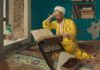
Cover image: Man Meditating Over the Qur’an, Osman Hamdi Bey (1902) © Meisterdrucke










No Comments